MA Filmmaking
- Study Mode: Full Time
- Location: High Wycombe
- Duration: One Year
- Start Date: September 2026
Do you have a passion for film? On our MA Filmmaking course, you’ll discover how to bring stories to life, developing technical and production skills including camera work, postproduction and single camera directing techniques. You’ll be taught by experienced media professionals on state-of-the-art equipment, and study the practical skills, contemporary technical knowledge and problem-solving ability for a range of production roles.
MA Filmmaking is designed with the film industry in mind. You’ll learn the essential skills needed for today’s dynamic film world, blending hands-on projects with key theoretical insights. This approach keeps you up-to-date with industry trends, ensuring you’re well-prepared for a smooth transition into your professional filmmaking career.
You’ll gain a comprehensive, hands-on education that blends individual skill development with collaborative projects. You’ll work on your own productions to master essential techniques like filming, editing, and post-production, while also joining group projects that mirror real-world film production challenges. This approach not only builds your technical expertise but also fosters teamwork, communication, and creative problem-solving. You’ll learn to manage both independent projects and group dynamics, ensuring you’re well-prepared for every aspect of the film industry.
At BNU, you benefit from a support system designed to nurture your talent and boost your career. Our experienced industry veterans provide personalised mentorship, offering insights and feedback that helps you shape your creative vision. Complementing this guidance, our career support services equip you with practical resources, workshops, and advice tailored to the film industry. This helps you develop both the technical skills and professional acumen needed to thrive in filmmaking, setting you on a clear path towards a successful and fulfilling career.
At BNU, networking is a key part of your learning experience. With access to industry events, guest lectures, and collaborative projects, you’ll have countless opportunities to meet professionals, peers, and potential mentors. These connections can open doors to future career opportunities and enrich your journey in filmmaking.
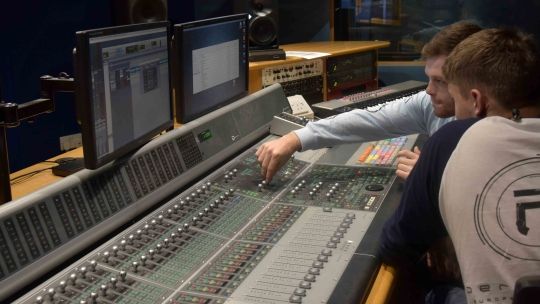
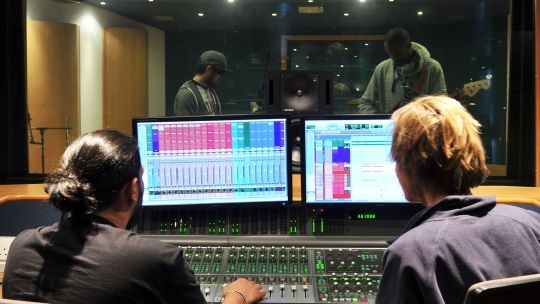
You’ll get to learn and create in a setting that mirrors real-world film studios. BNU provides you with access to state-of-the-art equipment, advanced editing suites, and cutting-edge production spaces. This access to the latest technology not only enhances your skills but also can also give you a competitive edge in today’s film industry.
What will I study?
On this course, you will be introduced to fundamental and advanced creative camera techniques and to camera peripherals. Across the twelve months of the course, you will work together with other students across three core modules and choose from a selection of optional modules. Creative and technical areas of advanced editing and post production will be explored, including software, standards for media production delivery and workflows. You’ll also be able to gaining cutting edge insights by guest speakers on this exciting course.
You will have the option to study advanced lighting techniques for specific environments that include studio, greenscreen and location. Depending on the modules you choose, you may also study screenwriting, writing a professional treatment and freelance writing skills, as well as script and screen analysis. Other options include the in-depth practice-based study of leading industry roles, with opportunities to focus on the creative and organisational roles of the director, the producer and production manager. Studying techniques of virtual production will prepare you for a crucial, developing area of the industry.
You will initiate and create a short film each term, and collaborate with fellow students on creative production work, making all aesthetic, editorial and production decisions while solving problems like those faced by real-life production crews. Tutors will constantly assess and constructively feedback on your work. These projects mean that you will graduate with a portfolio of writing, directing, cinematography, sound recording, editing, producing and production credits.
What facilities can I use?
Studying this course you'll have access to all the state-of-the-art facilities and equipment you need to kick-start your career.
Our Green Screen studio, video studios and editing suites are all kitted out with the professional-standard equipment you need. Our audio-visual editing suites include Adobe Creative Cloud suite, Final Cut Pro X, Blackmagic DaVinci Resolve and Avid Media Composer. The suites are acoustically treated and sympathetically lit.
Whilst studying with us you will also use our BucksAnywhere web service, which provides access to many of the software applications you use for learning and studying. BucksAnywhere can be used from your own device or from a University owned PC or laptop, from any location.
Our extensive range of HD broadcast camera include:
- URSA Mini Pro 4.6K
- over forty Panasonic cameras (AG-HPX301E, AG-HPX371E, AG-HPX171E and AG- Panasonic HMC41E)
- Canon XF305
- Canon 5D Mark III and Canon 60D cameras
- Blackmagic Pocket Cinema 4K cameras
- Sony A7R Mark III cameras
- and additional specialist cameras (GoPro Hero 7 cameras, a GoPro Fusion 360 camera, ZCAM E2 6K camera).
We also have a four camera live broadcast set up with Grass Valley LDK6000 cameras and industry-standard EVS action replay/asset management system with two XT3 servers.
In our individual video edit booths equipped with powerful iMac Pros and our communal editing suites and teaching rooms equipped with i9Macs, you’ll get the chance to become skilled with post-production software solutions including:
- Blackmagic Davinci Resolve
- Final Cut Pro X
- Avid Media Composer
- Adobe Creative Cloud suite
We also have an extensive lighting kit, sound studios, and sound equipment including:
- Sennheiser EW 100 radio mics
- Sound Devices 302 sound field mixers
- Sennheiser ME66 condenser microphone
- XLR microphone beach box adaptors for DSLR sound recording
- Sennheiser ME64/K6 condenser
BNU has invested in the latest technology to create a virtual production studio at our High Wycombe campus. Central to the facility is a 6m x 3m high-resolution 1.9mm LED wall, supported by a suite of advanced production tools that deliver a professional-grade virtual production environment. The system includes a tracked cinema camera, dynamic image-based lighting, and real-time graphics rendering powered by CJP’s Callisto workstation. Together, these technologies provide a seamless and immersive workflow that mirrors modern film and broadcast studios, giving students access to the same techniques used in industry.
How will I be taught and assessed?
You will be actively involved in a range of learning, teaching and assessment approaches as part of MA Filmmaking. Such active approaches aim to put you at the centre of your learning, so you are involved and engaged in all aspects of your assessment and learning. Your programme will require your active participation in learning activities and engagement with your fellow students both individually and collaboratively, working and learning with other students as part of a small group. Learning activities may also occur both within and outside the classroom.
Your learning will also be supported by technology. Increasingly your tutors will be using existing and emerging learning technologies to engage you in e-learning activities. Your programme will be facilitated using a variety of media and online tools (podcasts, wikis, etc) which will allow you flexible access to a diverse range of online resources, quizzes and learning materials as well as collaborative tools with which you can engage and learn with your peers. Not confined by the time and space associated with traditional teaching methods you may take part in online discussions and learning activities from wherever you are studying. Your tutors will provide any support you may need whilst learning online. By engaging with e-learning you will also be developing skills which are essential for your learning and are also highly valued by employers. These include but are not limited to working flexibly, communication, understanding of IT, team working and creating shared understandings based on quality resources and access to global expertise.
A variety of assessment vehicles will be used as appropriate to the modules you take, including assignments carried out in your own time, in-class assignments, workshops and presentations. Assessments will be appropriate to the task, achievable, motivating and vocationally focussed, forming a constructive part of your learning process.
What are the course entry requirements?
You should have the equivalent of a British Honours degree (2:1 minimum) in a relevant subject. If you do not have any formal academic qualifications but do have experience in the industry and previous training in a relevant area, or a suitable showreel, we will consider your application on an individual basis. We are very open to those who show relevant experience useful to the degree.
We are happy to consider equivalent qualifications from anywhere in the world.
If English is not your first language an IELTS score of 6.5 or equivalent when you start the course is essential.
We welcome applications from mature students with non-standard qualifications and recognise all other equivalent and international qualifications.
Modules
This provides a guide of the modules that make up your course. You can find more information about how your course is structured on our Academic Advice section.
What are the tuition fees
Home
-
Home, Academic Year 2026 - 2027: £11,420 per year *
International
-
Overseas/International, Academic Year 2026 - 2027: £16,280 per year *
Please note all of the 2026/27 fees stated are subject to parliamentary procedure. Tuition fees are expected to increase each academic year in line with the maximum permitted value set by the Government for that academic year. The expected rise for Home undergraduate students (including those on a foundation year course), may impact both new and continuing students.
Please note, distance learning and international fees are subject to change for 2027/2028 intake.
Additional costs
Your tuition fees cover most course costs, but you may need to budget for additional expenses. Work placements form part of this course and may involve additional travel costs. While placement providers will usually cover travel expenses where possible, students should budget approximately £200 per module for any associated travel costs.
Contact us
If you have any questions about the fees above, contact our enquiries team by completing this form.
What are my career prospects?
After you leave BNU, you might start as a researcher, production co-ordinator, 1st AD or a freelance scriptwriter for film or tv, or write content for the web. When you leave, you’ll feel confident in working with industry standard kit and will feel prepared for your first role within the industry.
Course leader