BA (Hons) Audio and Music Production
- Study Mode: Full Time
- Location: High Wycombe
- Duration: Three or Four Years
- Start Date: September 2026
Sound isn’t just background noise; it’s the heartbeat of any story. Think of the hush before a horror jump-scare, or the rolling bass that carries you through a game’s final level. Our BA (Hons) Audio and Music Production course puts sound design front and centre, giving you the chance to create everything from detailed Foley for film to wild, experimental sound art. You’ll be working in Dolby Atmos-certified studios, guided by lecturers who actually do this work for a living. It’s hands-on, it’s creative, and it’s all about learning the skills you’ll actually use.


Coming into BNU, I was not all that sure of what to expect however, meeting my lecturers, they had the reassuring aura and approachable demeanour that made learning easy and fun. The lecturers really did a tremendous job of putting our minds at ease to help us deal with stress in this course. In the studios, it's been great fun to use the Dolby Atmos system. It gives an insight and room for creativity when experimenting 3D audio by panning the objects.Danielle Ediale

We’ve designed this to be the most wide-ranging audio course at BNU, one that balances specialist sound design training with the flexibility to explore music production and audio theory. You won’t just be sitting in a studio on your own, either. You’ll be swapping ideas with animators, game designers, and advertising students, tackling projects that feel a lot like real client briefs. It’s collaborative, occasionally chaotic, and exactly the kind of environment that gets you ready for the industry. By the end, you’ll have a portfolio that doesn’t just show what you can do, it shows how you work.
Our course is designed to be practical and immersive. You'll get plenty of opportunities to work on real-life briefs and projects, helping you build a strong portfolio and gain valuable experience. From recording sessions to live sound setups, you'll be involved in every aspect of music production. This hands-on approach ensures you develop the technical skills and creative confidence needed to succeed.
BNU has a huge amount of industry connections, thanks to over 25 years of delivering music courses. Our network of guest speakers and alumni can provide you with insights and opportunities in the music business. You'll have the chance to attend industry events, workshops, and networking sessions. These connections can open doors to internships, job placements, and collaborations with established artists and producers.
A degree in Music Production from BNU opens up a wide range of career opportunities. Whether you see yourself in studio production, live sound, composing, or working within a record label, you'll be well-prepared to pursue your passion. Our graduates have gone on to work in various roles within the music industry, from sound engineers to music producers. The skills and knowledge you gain at BNU will equip you to adapt and thrive in this dynamic field.
Course Structure and Specialisms
In your first year, you’ll nail down the essentials, recording clean audio, editing it so it works, mixing so it pops, plus the music production and theory that help you understand the bigger picture. Second year is when you branch out into more complex areas: sound for moving image, interactive audio, and spatial mixing. You’ll also find yourself working on multi-disciplinary projects with students from other courses. By third year, it’s all about finding your own creative voice. You’ll take on a major final project, get professional development support, and pull together a portfolio that’s job-interview ready.
We also give you the opportunity to choose your specialism for your future career after your experience of the core curriculum in year one. Rather than having to make your big decision before you join us, we introduce you to various specialisms and offer you the flexibility to choose the specialism which leads to your chosen speciality. You can choose between BA (Hons) Audio and Music Production, BA (Hons) Music Production and BA (Hons) Music Production and Business.
These specialisms are also offered as four-year programmes, including an initial Foundation Year. The Foundation Year will allow you to develop your academic study skills and build confidence in your abilities, identifying your own strengths and development needs for progression onto an undergraduate programme.
We organise monthly ‘rec nights’ where music students come together to record their own compositions in our state of the art studios. This allows our students to practice their craft to ensure they are ready to enter the music industry.
What facilities can I use?
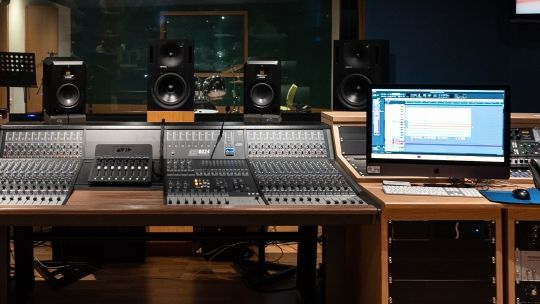
Our state-of-the-art recording studios and Dolby Atmos certified sound lab give you access to the space and technology you need. From individual edit rooms up to large Pro Tools Ultimate studios with attached live rooms and vocal booths, we have it all to help you gain hands-on experience.
- Studio 1 boasts a Dolby Atmos 7.1.4 speaker system and an Avid S6 console. We are one of the first Universities in the UK to adopt Dolby Atmos into a music environment.
- Studio 2 features an Audient ASP8024 Mixing desk, with outboard equipment by Neve, Universal Audio, Teletronix, Focusrite, Tegler, Maag, Manley and others. It also has monitoring by Genelec and Adam Audio.
- Studio three and the Electronic Music Studio are based around Avid S3/S4 control surfaces and UAD Apollo x8 audio interfaces.
- The edit booths are equipped with microphone preamps from Avid.
What will I study?
To reflect the real world, you’ll work as part of a production crew both on and off campus. You’ll collaborate with students from other courses, including Film & TV and Performing Arts on projects ranging from the screen to the stage. You'll also learn relevant business skills to help you tackle the challenges freelance technicians can face, including finance and legal guidance.
At its core, our Audio and Music Production programme aims to produce creative graduates with the necessary technical, theoretical and professional skills for employment within the creative industries. You’ll gain comprehensive training in key elements of music and audio production: studio production, location sound and post-production, music performance and composition, immersive audio techniques, critical listening and analysis, sound design, recording and mixing techniques and live audio production techniques.


How will I be taught and assessed?
Our teaching staff have a wealth of professional and academic experience, with many still actively working in the music industry. You’ll also engage with our dynamic programme of visiting lecturers and can benefit from live project briefs, master classes, and plenty of networking opportunities.
Previous live-industry briefs have seen students work at Glastonbury, Dolby and Pinewood Studios. You'll also get the chance to work with up and coming music artists. Previous artists have included the Ting Tings, Jake Bugg, and Florence and the Machine.
You’ll study in a close-knit tutor group where everyone’s input is recognised and valued. Not only will you be able to make friends for life, you’ll also make important connections that could last through your career, and you’ll form a network, just like you’d find in the working-world.
A variety of assessment methods will be used as appropriate to the modules you take, including essays, reports, portfolios of creative audio content, written evaluations, presentations, and some continuous assessment on practical tasks. Assessments will be appropriate to the task, achievable, motivating and vocationally focussed, forming a constructive part of your learning process.


What are the course entry requirements?
A typical offer will require a UCAS tariff score of: 88 - 112 (Full-time) or 32 - 56 (Foundation Year)
UCAS points can be obtained through qualifications such as A levels, T levels, BTEC or an Access to Higher Education course in a relevant subject. Please list all your qualifications on the application form as you will be asked to provide copies when we receive your application.
A minimum of two full A-levels (or equivalent) is required. Every application is considered on an individual basis.
For further details of our international English entry requirements, please visit our international pages.
If you don't meet the minimum requirements for the three-year undergraduate programme, or if you don't feel feel fully prepared for a degree course, you can apply for a four-year programme which includes a Foundation Year - find out more.
Modules
This provides a guide of the modules that make up your course. You can find more information about how your course is structured on our Academic Advice section.
What are the tuition fees
Home
-
Home Foundation Year, Academic Year 2026 - 2027: £9,790 *
-
Home, Academic Year 2026 - 2027: £9,790 per year *
International
-
Overseas/International Foundation Year, Academic Year 2026 - 2027: £15,910 *
-
Overseas/International, Academic Year 2026 - 2027: £15,910 per year *
Please note all of the 2026/27 fees stated are subject to parliamentary procedure. Tuition fees are expected to increase each academic year in line with the maximum permitted value set by the Government for that academic year. The expected rise for Home undergraduate students (including those on a foundation year course), may impact both new and continuing students.
Please note, distance learning and international fees are subject to change for 2027/2028 intake.
Additional costs
Your tuition fees cover most course costs, but you may need to budget for additional expenses. These can include specialist equipment, project materials, professional memberships, field trips or placements, as well as everyday student costs like printing, books and stationery.
Contact us
If you have any questions about the fees above, contact our enquiries team by completing this form.
What are my career prospects?
Our graduates go in all sorts of directions; sound design for film and TV, audio post-production, game audio, music production, even sports broadcasting at events like the Olympics and Formula 1. Some go freelance straight away; others dive into postgraduate study in areas like spatial or interactive audio. However you choose to work, you’ll leave with the technical skills, creative flair, and collaborative experience to get your foot in the door, and the work in your portfolio to keep it there.
As a graduate you can also go on to study a postgraduate course, such as MA Music Business or MA Music and Audio Production.
Course leader