BSc (Hons) Computer Science with Artificial Intelligence
- Study Mode: Full Time
- Location: High Wycombe
- Duration: Three or Four Years
- Start Date: September 2026
You can also study this course:
Explore AI from its history to philosophy and what it can and can’t do. You'll study machine learning, artificial neural networks, and data analysis and use industry tools including MATLAB and Jason. You'll consider ethics of AI and debate the benefits and challenges posed by AI developments.
This course is enhanced by alignment with certification programmes from major companies including Microsoft, Amazon Web Services (AWS), and Cisco which you can choose to take during your studies.


You will have the opportunity to work on real-world projects and collaborate with industry professionals, as well as participate in competitions, hackathons, and events. In the past we have invited in guest lectures, to share their experience and expertise and host day-long interactive events run by leaders in their field giving you the chance to put your knowledge into action.
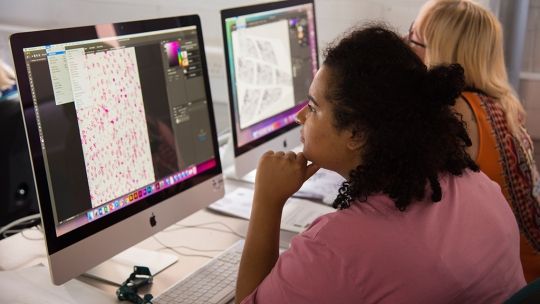
BNU has state-of-the-art computing labs outfitted with cutting-edge tech and software essential for computer science and AI. These facilities provide you with the opportunity to work on high-performance computing systems and delve into AI testing in a professional setting, closely resembling industry environments. You will have access to specialist labs equipped with dual-screen, dual-boot (Windows and Linux) systems loaded with the latest industry-standard software. Additionally, the university boasts a variety of devices, such as Virtual Reality headsets, 3D printers, Raspberry Pi microcomputers, and EEG headsets, which will serve as the foundation for various supervised projects undertaken throughout the program.
Artificial Intelligence is transforming industry and the world we live in. The field of AI is about so much more than creating generative AI like Chat GPT. Experts are applying their AI to improve care in hospitals, control robots in space, help companies understand buying habits, and more. By 2035, it’s predicted that AI activity could be worth an impressive £630 billion in the UK. A degree in this field will help give you the skills and knowledge you need to help play your part in shaping the future.
AI is one of the fastest-growing fields in the tech industry, and the demand for AI professionals continues to rise. This course prepares you for a variety of high-demand roles, such as AI specialist, machine learning engineer, data scientist, software developer, or AI researcher. The skills you develop will also make you highly employable in sectors such as finance, healthcare, robotics, automation, and gaming.
This course is enhanced by alignment with certification programmes from major companies including Microsoft, Amazon Web Services (AWS), and Cisco which you can choose to take during your studies.
You’ll explore the diversity of modern computer science and software engineering, gaining the integral skills required for today’s industry workplace. It doesn’t matter if you haven’t studied computing before or if you have experience but want to solidify your knowledge with a degree. This course is designed to accommodate almost all levels of prior learning.
In your second and third years, you will choose from optional modules covering a huge range of topics, from Algorithms and Data Structures to Cloud Computing, Cyber Security, and Artificial Intelligence.


What facilities can I use?
BNU has invested in our facilities to ensure that you can learn on industry standard systems and software, meaning that you can make an easy transition from education into employment. Quite simply we are committed to making sure we provide you with the best learning experience possible.
We make sure we keep the University’s computing facilities well maintained and equipped. We have a range of large labs; some being enhanced with cyber and A.I. specific facilities. Furthermore, many of these rooms are filled with dual-screen, dual boot (Windows and Linux) systems. Latest industry standard software is also included on devices to allow you to develop your skills to what is needed in the workplace.
Labs have been custom built to provide the best spaces to nurture the specific skills needed for game and internet development. These allow you to build your skills within key areas of future employment.
Hands-on experience is what we are all about. We have numerous devices that will provide the basis for various supervised projects you will carry out across the programme. These include but are not limited to Virtual Reality headsets, 3D printers, Raspberry Pi microcomputers, EEG headsets.
Furthermore, we provide online facilities to enhance your independent learning, via our Virtual Learning Environment. This will provide you with access to additional material and collaborative learning tools 24/7. And our virtual server technology will allow you to use our operating systems remotely.

What will I study?
As you start, you'll get to dive into both core computer science and specialised AI topics. The course starts with the basics like programming (in Python, Java, and C++), algorithms, software engineering, and database management, giving you a solid foundation in computing. You’ll also learn how computers work at a deeper level, studying operating systems and computer architecture.
As you progress, you’ll focus more on AI, starting with an introduction to how AI systems think and solve problems. You’ll study machine learning techniques, like neural networks and decision trees, and teaching computers how to learn from data. Later, you’ll explore deep learning, robotics, and natural language processing (such as voice assistants). Big data and data science also play a key role, teaching you how to handle large datasets and analyse data efficiently.
The degree also covers the math behind AI (probability, statistics, and calculus), and takes a look at the ethical side of AI, like privacy issues and how AI impacts society. In your final year, you’ll work on a major project, where you solve a real-world problem using AI. You may also get the opportunity for a work placement, to gain hands-on industry experience.
Optional modules let you dive into areas like cybersecurity, the Internet of Things (IoT), or user-friendly AI interfaces, depending on your interests.
You will also get opportunities to expand your knowledge both inside and outside of the lecture theatre. Students have previously visited sites of historical importance, including Bletchley Park, to learn more about the history of computing and how it impacted the world.
How will I be taught and assessed?
You’ll be taught through a mix of lectures, practical lab sessions, workshops, and tutorials. Lectures provide the theoretical foundation, while lab sessions focus on hands-on coding and AI development. Workshops and seminars will allow for interactive learning and collaboration with your peers, while small-group tutorials offer personalised support. A significant portion of your learning will also come from independent study and project work, where you can explore topics in-depth.
Assessment is a combination of coursework, practical projects, exams, and presentations. Coursework includes programming assignments and research projects, while practical projects assess your ability to develop AI systems and software. Some modules will have written exams to test your theoretical knowledge, and in your final year, you’ll complete a major project on a real-world AI problem. Presentations and group work are also part of the assessment, ensuring you develop both individual and teamwork skills. This approach balances both practical and theoretical learning, preparing you for a career in AI and computer science.
What are the course entry requirements?
A typical offer will require a UCAS tariff score of: 88 - 112 (Full-time) or 32 - 56 (Foundation Year)
UCAS points can be obtained through qualifications such as A levels, T levels, BTEC or an Access to Higher Education course in a relevant subject. Please list all your qualifications on the application form as you will be asked to provide copies when we receive your application.
A minimum of two full A-levels (or equivalent) is required. Every application is considered on an individual basis.
For further details of our international English entry requirements, please visit our international pages.
Those with no previous study, work experience, or who do not meet the specified entry requirements, including demonstrating the necessary knowledge and understanding, are welcome to apply for the 3-year BSc (Hons) degree, however may be offered the four-year programme which includes a Foundation Year.
Modules
This provides a guide of the modules that make up your course. You can find more information about how your course is structured on our Academic Advice section.
What are the tuition fees
Home
-
Home Foundation Year, Academic Year 2026 - 2027: £9,790 *
-
Home, Academic Year 2026 - 2027: £9,790 per year *
International
-
Overseas/International Foundation Year, Academic Year 2026 - 2027: £15,910 *
-
Overseas/International, Academic Year 2026 - 2027: £15,910 per year *
Please note all of the 2026/27 fees stated are subject to parliamentary procedure. Tuition fees are expected to increase each academic year in line with the maximum permitted value set by the Government for that academic year. The expected rise for Home undergraduate students (including those on a foundation year course), may impact both new and continuing students.
Please note, distance learning and international fees are subject to change for 2027/2028 intake.
Additional course costs
Your tuition fees cover most course costs, but you may need to budget for additional expenses. Students studying this course should budget approximately £45 for travel to the industry conference, including return train fare and a Tube travelcard.
Contact us
If you have any questions about the fees above, contact our enquiries team by completing this form.
What are my career prospects?
Throughout your time with us we’ll support you on the route to your chosen career. We’ll help you to develop crucial skills, encouraging you to become enterprising, employable and good leaders. We also help you find employment after graduation. Have a look at our Careers and Employability pages to find out more.
AI is becoming integral our everyday life and is key to solving many challenges that different sectors face. After studying at BNU, you’ll be ready for a range of AI roles, such as:
- machine learning engineer – build and manage platforms for machine learning projects
- business intelligence developer – design, model, and maintain complex data in cloud-based data platforms
- artificial Intelligence architect – provide AI solutions to help businesses
- robotics scientist – build and maintain software for robots that do tasks with varying human input.
You may also choose to stay on at BNU and study a postgraduate programme.
Course leader